With renewed hope, the €4.7 million Taï-Grebo-Krahn Conservation Project is being relaunched. But the true measure of its success will be how the population responds to the conservation of their forests.
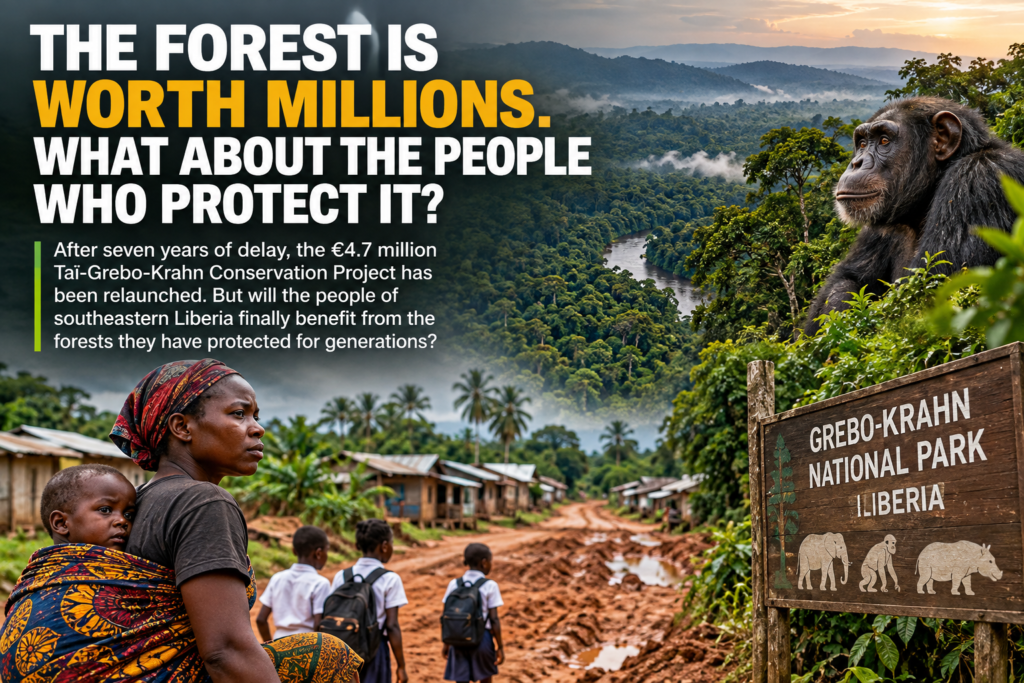
THE FOREST WORTHS MILLIONS: WHAT ABOUT THE PEOPLE WHO PROTECT IT?
The Perspective
In the counties of Grand Gedeh and River Gee, people have lived side by side with the tropical forests of their country for centuries. For generations, these people have used the forests directly, which provided their food, medicine, shelter, and livelihood. Before international conservation organizations arrived with their multimillion-dollar projects, these communities recognized the importance of protecting their natural environment. Today, these forests attract millions of dollars from abroad for their preservation, but their inhabitants still struggle with impassable roads, inadequate health care, educational and job difficulties, and a lack of safe drinking water.
This contradiction is disturbing.
But how can a forest have any value at all to the international community when the people who have lived alongside it for generations were not given a penny? The Liberian government faces the question of how to relaunch the Taï-Grebo-Krahn conservation project, which was suspended in 2017.
A promising project with an unfinished history
On September 3, 2026, the Forestry Development Authority (FDA), in partnership with the Wild Chimpanzee Foundation (WCF), relaunched the Taï-Grebo-Krahn Biodiversity Protection Project in Ziah City, Konobo District of Grand Gedeh County. Financed by the German government through KfW Development Bank, the project has a reported budget of €4,718,065.74, approximately US$5.4 million. Its objectives include improving the management of Grebo-Krahn National Park, strengthening forest surveillance, recruiting rangers, and protecting endangered wildlife. Liberia’s forests are national assets of enormous economic and ecological value. The Grebo-Krahn National Park alone covers about 97,136 hectares and is home to chimpanzees, forest elephants, pygmy hippopotamuses, and hundreds of other species of animals and plants. They are important ventures. The history of this program is not yet complete. First proposed in 2017 at an estimated cost of €6 million, it has faced years of delays. Now it is being relaunched at an allegedly reduced cost.
What happened during these years? What was accomplished, and why did the work stop? How much of the initial funds were used?
These questions deserve clear answers. The difference between the original and revised budgets is not financial impropriety, but it needs a transparent explanation.
In seven years, the life of a rural community has changed a lot. A child who started school when the project was approved will be approaching his youth. Farmers who counted on a passable road in 2017 will still have to arrange transport for their products to market. Development cannot be measured only by the signing of agreements or the announcement of projects; it must be measured by what really changes in people’s lives.
A forest cannot thrive while its communities suffer
Projects are said to have been relaunched to build community roads, build schools, health centers, provide hand pumps, and to erect 150 solar lights. Training for more than 300 people, job creation, and the establishment of cooperative and savings funds were also planned.
These promises were encouraging. But for the inhabitants of Grand Gedeh and River Gee, they needed more than promises of all kinds. Consider the pregnant woman who, to reach the nearest health center, must pass a bad road. Consider the farmer whose harvest spoils because of a muddy road to the market. Consider a young man who sees expensive cars and expensive equipment arriving in his community, but who is not being employed. The people to whom the word conservation has been addressed regard it not as a distant and esoteric notion but as a question of survival, a matter of opportunity, and a concern for the future of their children. If conservation measures are undertaken to preserve endangered species, they risk losing the support of the very people whose cooperation is necessary for their success. They must know that preserving the environment and developing the people are not contradictory goals, but inseparable.
The people must have a seat at the table
A question that arises at this point is: what rule will govern the expenditure of the funds set aside for the advancement of the community? Then the question arises: will development priorities be set locally, by the residents of the country, or by the authorities in Monrovia and foreign headquarters? A community that urgently needs a bridge must not be given a building it has not been asked for. A village without water must be allowed to decide whether streetlamps are most important to it. Involving the community means more than simply inviting the authorities to the inauguration. Women, youth, farmers, and all those who depend on the forest must be included in all decisions, their implementation, and monitoring. They must know what has been promised, how much has been allocated, who is responsible for implementation, and when construction will begin. The FDA and the WCF should publish a plan for each community so that the inhabitants can follow up. People should not have to wait for another launch ceremony to find out what has happened to their project.
The warning from Konobo
Here is one indication why communal life cannot be regarded as a secondary matter. In August 2026, The DayLight reported that the FDA had regained access to the Grebo-Krahn National Park after a quarrel with the authorities of the Konobo region. The dispute reportedly concerned the destruction of cocoa plants and the violation of local customs, but a solution was later found that allowed the rangers to continue their work.
It is a typical example of the importance of preserving the people’s native land, their ancestors’ land, and their right of use. Penalties alone cannot make conservation succeed. If a family loses access to its land or its customary forests, it should have an opportunity to complain and should be compensated for any injury caused. If conservation laws restrict the family’s income, it must be given practical alternatives. This new project should focus on establishing a mechanism that offers meaningful support to affected people, especially the poor. In this way, problems can be resolved before they lead to conflict. You must treat locals as partners in forest protection, not as obstacles to conservation.
Where will the money go?
The project’s financial arrangements should be publicly accessible. We should be told how much of the €4.7 million will go to administration, equipment, vehicles, personnel, local community benefits, forest monitoring, and so on. What is the extent of their participation in Liberia? How many Liberians will they hire? Which of the contracts will be awarded to Liberian companies with proven competence? The government and its partners should publish the approved budget, procurement plans, implementation plans, and quarterly financial reports. This would be a good time to explain the earlier delays and the safeguards put in place to prevent recurrence. Transparency is not directed against conservation or development associations. It is necessary to preserve public confidence and achieve results worthy of lasting credit.
Three years to demonstrate real progress
The recently announced three-year plan affords an opportunity to establish measurable goals. By the end of the first year, a comprehensive list of roads that have been surveyed and opened, and the outlines of construction work on the local road network, with the names of the villagers who have been employed, and all the development programs in place, should be drawn up by the village leaders. By the second year, infrastructure, employment, training, and forest protection should show visible progress.
In the third year of the project, the government and its collaborators should be able to provide objective, verifiable information on the work done.
A report on the sessions, meetings, and conferences will not suffice. In a functioning town, there must be usable roads, wells that supply water, work that provides a steady income, and schools or hospitals that provide services. At the same time, independent environmental controls are being introduced to assess whether forest protection has improved and whether risks to animals and their endangered habitats have been reduced. Both outcomes matter.
The government cannot abandon its responsibility
External conservation aid is essential, especially for a country such as Liberia, with such a large forest area and limited public resources.
But donor-funded projects must not replace the government’s responsibility to provide basic social services. A major challenge was coordinating the development of Taï-Grebo-Krahn with county development plans, national road-construction priorities, and agricultural development programs. Roads constructed under the project must have maintenance arrangements; hospitals and dispensaries must have staff and equipment; schools must have teachers and teaching materials. Otherwise, buildings and public works will deteriorate long after the international effort ends. Conservation investments should leave institutions and opportunities behind to endure beyond the funding period.
Let this project leave a different legacy
The renewal of the Taï-Grebo-Krahn Conservation Project will give Liberia the opportunity to demonstrate that it can conserve its natural resources while improving the livelihoods of its people. The German government deserves our thanks for its support for forest conservation. The FDA and WCF have the important task of ensuring that this support produces good results. Traditional authorities, local authorities, and county officials also have an important role to play. But the worthiest beneficiaries of these forests must be the people who have lived beside them for generations. When this project is completed, its value should not be measured by the number of hectares of forests protected, the number and quality of vehicles purchased, or the number of reports produced.
It should also be measured by the mother who has access to a medical service without risking her life on a debilitated road, by the farmer who can take his harvest to the market, by a young man who has found a job that gives him a purpose, and by children who can attend a school that is in good repair.
These are the human faces of conservation. After seven years of uncertainty, the people of southeastern Liberia can expect transparency, accountability, and concrete progress. The forest deserves to be saved. The Liberian people deserve to be prosperous. Liberia must give them both.