FACT CHECK: No Evidence that the HPV Vaccine Will Kill Liberian Children Or Cause Infertility
A video circulating among Liberians is sounding an alarm about the HPV vaccine, warning parents against allowing their children to receive it and raising fears about deaths, infertility, and the claim that the vaccine is being presented to prevent cancer.
The Perspective
A video circulating among Liberians is sounding an alarm about the HPV vaccine, warning parents against allowing their children to receive it and raising fears about deaths, infertility, and the claim that the vaccine is being presented to prevent cancer.
Parents have every right to ask questions about a vaccine being offered to their children. Liberia’s Ministry of Health also has an obligation to explain clearly what is being administered, why it is needed, what side effects are possible and how vaccine safety is monitored.
But legitimate questions should be separated from claims for which there is no credible evidence.
After examining the principal claims made in the circulating video and comparing them with information from Liberia’s Ministry of Health, the World Health Organization (WHO) and the U.S. Centers for Disease Control and Prevention (CDC), The Perspective finds no credible evidence that HPV vaccination causes infertility or will kill children.
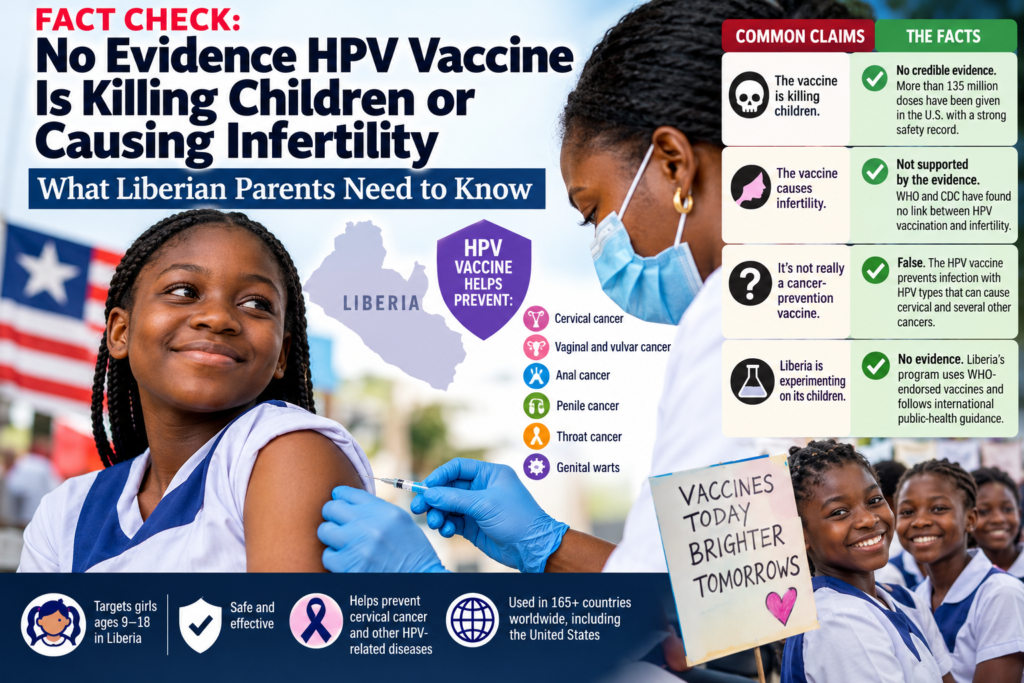
CLAIM 1: The HPV vaccine is being falsely presented as a cancer-prevention vaccine.
FACT CHECK: FALSE.
HPV vaccination is genuinely a form of cancer prevention. Human papillomavirus is a group of viruses transmitted primarily through intimate skin-to-skin and sexual contact. Most HPV infections disappear naturally, but persistent infections with certain high-risk HPV types can eventually cause cancer. HPV is responsible for virtually all cervical cancers and can also cause cancers of the vagina, vulva, penis, anus and oropharynx: the back of the throat. Some HPV types cause genital warts.
The vaccine works by preventing infection with HPV types responsible for many of these diseases. It does not treat existing cancer. This distinction is important: children are vaccinated today to reduce their risk of developing HPV-related cancers years or decades later. The HPV vaccine has been shown to reduce the incidence of HPV infections, genital warts, and precancerous lesions.
CLAIM 2: Why vaccinate children against a sexually transmitted virus?
HPV is generally transmitted through sexual contact. This is why vaccination against it is recommended before exposure to the virus occurs. If a nine-, ten-, eleven-, or twelve-year-old child is given a vaccine against this infection, it does not mean that health authorities believe the child is sexually active. The aim is to develop immunity before possible exposure later in life.
In the United States, HPV vaccines have been used since 2006. American authorities recommend routine HPV vaccination during childhood and adolescence, including for boys as well as girls. The CDC explains that the HPV vaccine works best when given before HPV infection.
CLAIM 3: The HPV vaccine causes infertility.
FACT CHECK: NOT SUPPORTED BY EVIDENCE.
This is one of the most serious allegations because fear about a daughter’s future ability to have children can understandably frighten parents. The World Health Organization’s Global Advisory Committee on Vaccine Safety specifically investigated claims linking HPV vaccination with infertility and premature ovarian insufficiency. The Committee’s review of hundreds of scientific papers and examination of relevant studies led to the conclusion that the available evidence does not support a causal relationship between HPV vaccination and infertility or premature ovarian insufficiency. The CDC and the U.S. Food and Drug Administration likewise report that they have found no evidence that HPV vaccination causes reproductive problems in women.
Ironically, cervical cancer itself, and treatments including surgery, chemotherapy and radiation, can sometimes affect a woman’s ability to have children. Preventing HPV-related cancers can therefore help avoid those consequences.
CLAIM 4: HPV vaccination is killing children in America.
FACT CHECK: NO CREDIBLE EVIDENCE SUPPORTS THIS CLAIM.
More than 135 million doses of HPV vaccines have been distributed in the United States, according to the CDC. The vaccines have been monitored through multiple vaccine-safety systems. The CDC reports that common reactions include pain, redness or swelling where the injection was given, dizziness, fainting, nausea and headache. Serious allergic reactions can occur after vaccines, but they are rare. The CDC reports anaphylaxis after vaccination generally at approximately three cases per million doses administered.
More importantly, a health problem reported after vaccination does not automatically mean the vaccine caused it. Systems such as the U.S. Vaccine Adverse Event Reporting System (VAERS) accept reports of events occurring after vaccination so potential safety signals can be investigated. The CDC specifically cautions that a VAERS report by itself generally cannot establish causation.
The World Health Organization’s vaccine-safety experts have likewise repeatedly reviewed HPV vaccines and continue to report a favorable safety profile.
CLAIM 5: Is Liberia experimenting on its children?
There is no evidence in the material reviewed by The Perspective establishing that Liberia’s HPV campaign is an experiment.
Liberia’s Ministry of Health officially launched its nationwide HPV vaccination campaign on November 17, 2025.
The Ministry said the campaign targeted approximately 560,000 girls ages 9–18, with a goal of reaching 90 percent of the target population. Health Minister Dr. Louise Mapleh Kpoto urged parents to take advantage of the free vaccination opportunity.
The Ministry’s Expanded Program on Immunization described the HPV vaccine as safe, effective and endorsed by WHO, and said early vaccination substantially reduces the risk of cervical cancer later in life.
Globally, this is not an obscure vaccine being tried only in Liberia. WHO reported that 165 countries had introduced HPV vaccines by the end of 2025.
Questions Liberia’s Ministry of Health should still answer
Rejecting misinformation should not mean discouraging scrutiny.
The Ministry of Health should make easily accessible to Liberian parents the exact HPV vaccine product being administered, manufacturer, WHO-prequalification status, procurement and funding arrangements, batch and expiration controls, cold-chain procedures, adverse-event reporting system, and consent or opt-out procedures for children vaccinated through schools.
Parents should also be told clearly what common side effects to expect, where to report suspected serious reactions, and what follow-up will occur.
Transparency builds confidence. Silence creates space for rumors.
Liberians should therefore reject two extremes: blindly accepting every claim simply because it comes from government or accepting frightening social-media allegations simply because they are delivered passionately.
Ask questions. Demand documentation. Require transparency.
But the evidence matters.
Based on the evidence reviewed by The Perspective, the claims that HPV vaccination causes infertility or is killing children are not supported by credible scientific evidence. The claim that HPV vaccination can prevent cancer, particularly cervical cancer, is well established.
Liberian parents deserve facts [not fear].
______________________________________________________________________________________________________________________________
Sources
Liberia Ministry of Health: “MOH, Partners Launch Nationwide HPV Vaccination Campaign to Protect Girls Against Cervical Cancer,” November 17, 2025.
World Health Organization, Global Advisory Committee on Vaccine Safety: “Human papilloma virus vaccines and infertility.”
World Health Organization: HPV vaccine safety reviews and 2026 safety update.
U.S. Centers for Disease Control and Prevention: “HPV Vaccine Safety and Effectiveness Data.”
U.S. Centers for Disease Control and Prevention: “Human Papillomavirus (HPV) Vaccine Safety.”
U.S. Centers for Disease Control and Prevention: “Impact of the HPV Vaccine.”