Former President Sirleaf: Before lecturing us on Accountability, Recall Your Own Record
Former President Ellen Johnson Sirleaf this week came back to the national stage with a powerful speech on the need for accountability and the need to transform the socioeconomic system of Liberia.
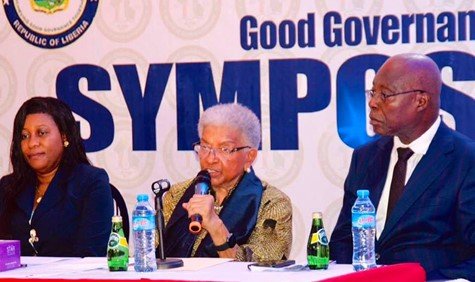
Photo: Courtesy of THE ANALYST
By George H. Nubo
Former President Ellen Johnson Sirleaf this week came back to the national stage with a powerful speech on the need for accountability and the need to transform the socioeconomic system of Liberia.
Much of what she said deserves serious attention. But listening to the incongruous sound of Madam Sirleaf’s voice, an awkward question occurred to one. Where was this same urgency when she had the power to do something about it?
From 2006 to 2018, Ellen Johnson Sirleaf was the most powerful woman in Liberia. She found her country in ruins after fourteen years of civil war and received a large share of international goodwill. Liberia’s development partners rallied around her government; billions of dollars were granted for reconstruction; the Liberians swarmed around their president.
She was able to do something the present president cannot: give her policy twelve unbroken years in which to put it into action. That is why her speech of October 6 must not be judged apart from the record of her entire career.
“We Did Not Win”
To the credit of Madam Sirleaf, she said something which few leaders would have ventured to acknowledge.
Speaking at the Governance Commission symposium, she said:
“I wish I could tell you that with all of this effort we won the corruption fight. We did not, and we are facing the same thing today.” She went even further. She acknowledged that audits were published and forgotten and that too few cases reached court. That is a remarkable admission.
But it immediately raises another question:
Who was President when those audits were being published and forgotten? Madam Sirleaf was not sitting in the opposition. She was President.
John Morlu Warned the Country
Take, for example, the experience of former Auditor General John S. Morlu II. In 2007, Madam Sirleaf herself appointed Morlu to the post of Auditor General. Since then, the General Auditing Commission had been producing very harsh audits, which led to embarrassing inquiries into public expenditure and the issue of corruption.
Morlu did not always make himself popular. But an Auditor General is not appointed to make politicians comfortable. Later, newspaper reports of the time show that only a few of the over twenty audits, which the GAC had recommended for criminal investigation, were carried out by the Justice Ministry.
Morlu was eventually not renominated.
Today, Madam Sirleaf says audits were published and forgotten. Liberians should therefore ask:
Why wasn’t a more energetic effort made to implement the recommendations of the auditors while she controlled the Executive Mansion? If “Accountability begins at the top,” as Madam Sirleaf says now, then the top was in those days at the Executive Mansion, and she occupied it.
Then There Was NOCAL
The National Oil Company of Liberia is a second page that cannot be lost in the history of the people of Liberia. Robert Sirleaf, the former President’s son, served as chairman of NOCAL’s Board of Directors. During later audits covering fiscal years 2012 through 2015, the GAC uncovered some serious financial irregularities, largely at the time that Robert Sirleaf was chairman of the NOCAL board. This does not prove that Robert Sirleaf bankrupted NOCAL, and no responsible criticism should presume that fact.
Nevertheless, it was eventually thrown into severe financial difficulties, underwent restructuring and staff reductions, and became one of the most controversial public bodies of the Sirleaf regime. So let us apply Madam Sirleaf’s own words:
“Accountability without consequence is only a report on a shelf.”
Precisely. What consequences followed? Who answered about NOCAL’s financial collapse? Which officials were held personally responsible for the irregularities revealed by the lawful audits? Those are questions that history is entitled to ask.
Madam Sirleaf, You Renegotiated Firestone
Perhaps the most striking part of Sirleaf’s new speech concerned Firestone. She reminded Liberians that in 2026 they would have reached the one-hundredth anniversary of the start of the Firestone concession, and she deplored that after a century of producing rubber:
“Not a single tire has been made.”
It is a powerful line. But Madam Sirleaf left something important unsaid. Her administration renegotiated the Firestone concession. In 2006, when she had become president, Sirleaf had demanded that the agreement, which Firestone had reached during the transitional period, be renegotiated. The new agreement, signed in 2008, extended the lease until 2041. To be fair, her government obtained improvements. Firestone’s income tax increased, rubber prices were raised, and a series of obligations for housing, education, the environment, and investment was introduced. Those accomplishments should be acknowledged. But that makes today’s question even more important.
If it were the case that for a century the export of raw rubber, without any tire industry, represented a failure in the structure of our economy, as Madam Sirleaf claims, why wasn’t the transformation of this industry made the centerpiece of the concession renegotiation which her government undertook? she had the opportunity; she had leverage; she had international support; and she was president for twelve years. It is not a question of blaming Ellen Johnson Sirleaf for a treaty which was signed in 1926. The question arises what she did when history laid the pen in her hand.
And What About Ebola Money?
Liberians should also remember the Ebola crisis. The plague was terrible. People were dying, doctors and nurses were dying; the hospitals were crowded with patients; the families could not bury their dead normally. No sensible person could claim the officials were acting under ordinary circumstances.
But extraordinary circumstances do not erase accountability. They make accountability even more important. Questions were raised about the procurement and expenditure on Ebola, and audits have uncovered inefficiencies and irregularities. During the crisis it may be that certain procedures were not followed to the letter while lives were being lost.
The exigency had passed. And every suspicious penny had to be cleared up. That is the difference between explaining an irregularity and excusing it. Then, if Madam Sirleaf today says that audit reports must not gather dust, then Liberians have every right to ask what happened to the Ebola audit which was conducted under her presidency.
“Stop Following America” But What Does She Mean?
After her October 6 speech, Madam Sirleaf reportedly told journalists:
“We have to stop following the United States of America. Let’s join a new era of sovereignty and respectability that Africa is pushing.”
That statement deserves clarification.
Liberia should think independently no doubt; no sovereign nation should blindly follow the example of another. But Madam Sirleaf should explain what she means. Which American policies should Liberia stop following? Foreign policy; economic policy; Governance; or social policy? Liberians should not put words in her mouth.
However, it would be to examine such a statement, especially from a former president whose administration had the closest political, economic, and diplomatic relations with the United States. The influence of the United States was acceptable when Washington strongly supported her government, so what has changed now?
That is a fair question.
Liberia Must Also Remember Its Painful Past. There is another uncomfortable chapter. At the beginning of the Liberian civil war, Madam Sirleaf’s relationship with Charles Taylor’s movement has been long and hotly disputed.
We should be precise.
The historical record does not permit a simple statement that the civil war in Liberia was “launched” jointly by Ellen Johnson Sirleaf and Charles Taylor. But history must not allow Sirleaf’s early sympathy for Taylor’s NPFL movement to be obliterated, or the financial assistance that she channeled through the Association for Constitutional Democracy in Liberia.
Liberia’s civil war destroyed families, communities and an entire generation’s opportunities. Thousands died. Hundreds of thousands were displaced. Anyone who was in any way involved in the political environment surrounding this catastrophe must look at the history of the Republic of Liberia with humility. And that applies not only to Ellen Johnson Sirleaf. It is true of all the leaders who figured in the terrible period.
President Boakai Must Be Judged Too
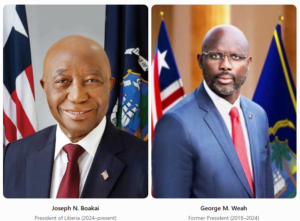
None of this means President Joseph Nyuma Boakai should escape scrutiny. Absolutely not. If President Boakai misuses public resources, protect him from no audit. If his ministers steal, investigate them. If his relatives improperly benefit from government, expose it. If his administration violates procurement laws, publish the evidence. If corruption occurs, prosecute those responsible. That is what accountability means.
But the question of a trial does not become urgent simply because another person has now occupied the Presidency. The standard Madam Sirleaf proposes must apply backward and forward. It must apply to Boakai; it must apply to Weah; and it must apply to Sirleaf.
Take the Reports Off the Shelves
Madam Sirleaf gave Liberia one particularly memorable sentence: “Accountability without consequence is only a report on a shelf.” On that, she is right. So, perhaps, Liberians should accept her challenge literally.
Let us take the reports off the shelves.
Take down the John Morlu-era GAC reports.
Take down the NOCAL audits.
Take down the Ebola audit reports.
Take down the concession reviews.
Examine the recommendations.
Ask which recommendations were implemented.
Ask which cases were investigated.
Ask which cases were prosecuted.
Ask who was protected.
Ask who was punished.
And ask why.
That is not revenge.
That is accountability.
Madam Sirleaf has the right to talk about the future of her country. As a former President, a laureate of the Nobel Peace Prize, one of the most recognized stateswomen in Africa, her words will be heard. But her record must also remain open to examination.
As for the President’s leadership and responsibility, these do not come to an end once he has left the Executive Mansion. If the culture of accountability that Madam Sirleaf now demands is to be built on firm foundations, there should be no sacred cows, past or present. Madam Sirleaf says the reports have been sitting on the shelves for too long. Perhaps it is high time to take her advice. Bring them down. Open them. Read them. Let the facts speak.
______________________________________________________________________________________________________________________________
Sources
The Analyst — Sirleaf’s October 6, 2026 Governance Commission address:
“EJS Demands Structural Transformation — Admits Anti-Graft Crusade Fell Short in the Past.”
FrontPageAfrica — October 7, 2026:
“Liberia: Ex-President Sirleaf Admits Her Government Failed to Defeat Corruption, Says Menace Persists.”
Liberia News Network — Sirleaf’s statement on the United States:
“Sirleaf Warns Liberia Against Following U.S., Points to Africa’s Sovereignty Push.”
ProPublica — John Morlu/GAC and corruption investigations:
“Follow the Money: Payment Trail Reveals Challenges of Ridding Liberia of Corruption.”
General Auditing Commission reporting/FrontPageAfrica — NOCAL:
“Audit Report: NOCAL Purchased Swamp Land for US$700K.”
Open Society Foundations/Revenue Watch Institute:
“Getting a Better Deal from the Extractive Sector: Concession Negotiation in Liberia, 2006–2008.”
European Rubber Journal — February 26, 2008:
“Liberia, BFS Sign Amended Rubber Concession Agreement.”
ProPublica/FRONTLINE:
“Firestone and the Warlord.”