
“I find it really amazing that many of Liberia’s citizens, even many of its leaders and bright minds, still celebrate foreign aid. This country that is almost 200 years old, still has its begging bowl out in a {dignified} way. I will not be surprised if we will be depending on the same donor to finance the operation of the facility. When will we be embarrassed to publicize this level of dependency? Very perplexing.” – William Nyanue
There is a difference between dependency and partnership
By George H. Nubo
“I find it really amazing that many of Liberia’s citizens, even many of its leaders and bright minds, still celebrate foreign aid. This country that is almost 200 years old, still has its begging bowl out in a {dignified} way. I will not be surprised if we will be depending on the same donor to finance the operation of the facility. When will we be embarrassed to publicize this level of dependency? Very perplexing.” – William Nyanue
Mr. Nyanue, I understand where you are coming from. And frankly, I share part of your concern.
After nearly two centuries as an independent nation, Liberians should certainly be asking some hard questions about why we still depend so heavily on foreign assistance for many basic services. We cannot keep forever looking outside our borders to find solutions to problems we must develop the capacity to solve ourselves.
But I think we must make an important distinction: There is a difference between dependency and partnership.
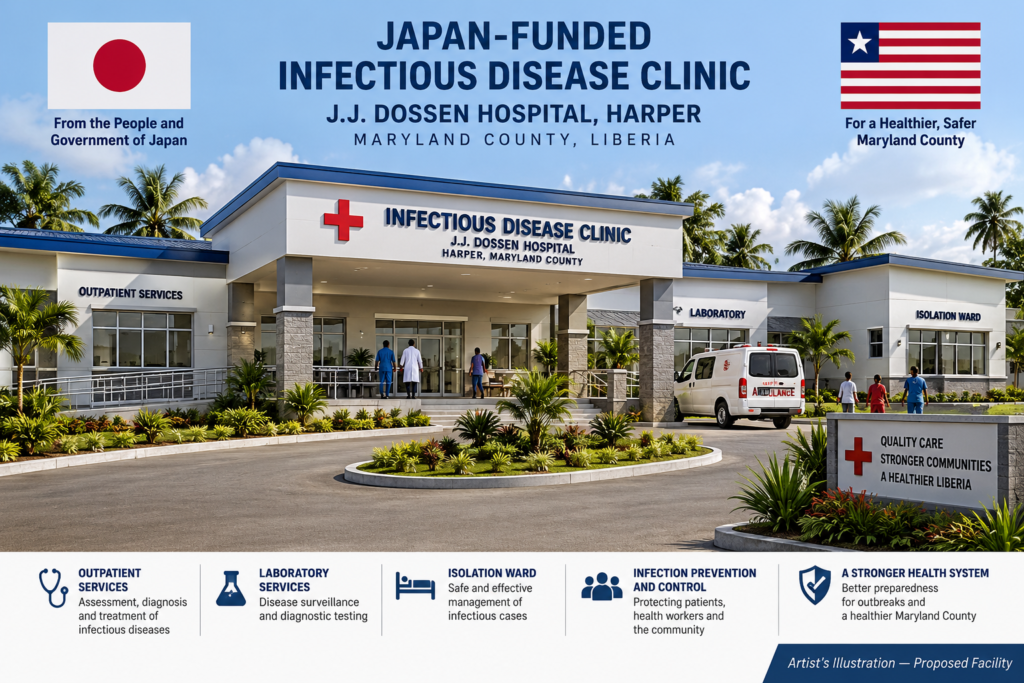
If the people and Government of Japan are willing to provide approximately US$1.6 million for the construction of an infectious-disease facility in Maryland County, I do not think we ought to be ashamed of accepting the aid with thanks. It is a facility which may save Liberian lives. It will help to strengthen health care in Maryland County and the Southeast and improve our ability to respond when infectious diseases threaten our communities.
There is no shame in accepting a helping hand from a friend.
The problem begins when that helping hand becomes the only hand doing the work. And that is where I believe your concern deserves serious attention. When the building is completed and the ceremonies are over, who will keep the doors open?
Who will pay the doctors, nurses, laboratory technicians, cleaners and other workers?
Who will provide the medicines and laboratory supplies?
Who will pay for electricity and water?
Who will repair the equipment when it breaks down?
Those are the questions we should be asking now-not after the Japanese have completed the project and gone home. Japan can help us build the facility, but Japan should not be expected to operate it forever. That responsibility belongs to Liberia.
And this discussion goes beyond one clinic in Maryland County. Liberia is not a country without resources. We have iron ore, gold, forests, rubber, fisheries, arable land, and other natural resources; our government collects taxes, royalties, concession fees, and other revenues.
So, we must also ask ourselves a difficult question: What are we doing with what we already have? For me, that is the heart of the matter. Japan’s support is very much welcome, and I have the deepest respect for the generosity of the Japanese people. But the esteem we have for our partners in the international community must never prevent us from demanding responsibility from our own government.
I would, therefore, like to hear from the Ministry of Health, Ministry of Finance and Development Planning, Maryland County authorities and our Maryland Legislative Caucus:
What is Liberia’s plan for this facility after construction?
Tell us how it will be staffed. Tell us what it will cost to operate each year. Tell us where the money will come from for medicines, electricity, maintenance and equipment. And most importantly, show us where Liberia’s commitment appears in the national budget.
That is the conversation I believe we should be having.
We should not reject foreign assistance simply to prove that we are independent; this would help no one. Our goal should be to make good use of international partnerships, while steadily building the capacity to take care of ourselves.
Japan can help us put up the building, but keeping the lights on, keeping medicines on the shelves, keeping health workers paid and keeping the doors open for the people of Maryland County must ultimately be our responsibility.
Let us thank our friends when they help us.
But let us also challenge ourselves to build a Liberia where, one day, such help is welcomed as a partnership – not depended upon as a necessity.
That is the kind of independence worth working for.
- George H. Nubo





In international relations, nations forge relationship for many reasons against the background that the world is now a “Global Village” wherein connectivity amongst and between citizens of the village are interconnected in view of the relevance of their respective relationships – such could be commerce, education, science – an area which supports the creation and or manufacturing of Medicinal Products and other things which are derived from such relationships- and squarely that cannot be described as dependancy; rather than it being described as stated by the individual whose description necessitated Mr. Nubo ‘s pointed response, that kind of of gesture is described as “International Assistance” and the recipient – the Republic of Liberia can not be seen as a nation who depends on external “Hand Outs” which I surmise is being referenced – to the contrary, that is absolutely not the case!
The Stark Difference Between Begging And International Assistance
It should be fully understood by anyone who harbors such negative views that begging, which is a factor of dependency is different from [than] an offer or “Good Will” of an international partner. And in many instances, it is reciprocal – or it called “Reciprocity” and going back to years before now it can be likened to “Batter Trade” where before now, one would trade Maligueta Pepper for Salt or other commodities in trading.
The questions we must be asking ourselves now given what will our roles be and how as citizens and government, how can we help to maintain the facility? Does Liberia have the Radiologists and experts who are ready to fully administer the hospital, if it is a “Turn Key Project” where it is constructed and administered for a few year, then turned over to the government – what then are we capable of doing to keep the facility and equipment effectively running; or will it be left in ruin?
George I am happy to hear that the Perspective is back. Looking forward to publishing on the platform once again.
Obviously I differ with you on some aspects of your post on this issue. I am hoping to submit an article to the Perspective in the not-too-distant future on this and similar issues.
I think there are two very important issues in your piece that lie at the foundation of Lineria’s chronic dependency problem.
1. We delude ourselves into believing that these foreign nations that give us their tax payers’ monies are our “partners”. I think it is about time we define what this term-partners–means. I believe in a partnership both parties share the burdens and benefits of the relationship, maybe not to the same degree. It would be very helpful if someone can say how our “partners” benfit from the partnership they have with us. I think we just do not want to make ourselves feel bad by calling the thing by its proper name. And maybe this dependency problem has lasted this long because we and our leaders are conditioned to use what is really a euphemism and not call the thing by its real name
2. The second delusion, I think, is the belief that generosity and benevolence is, at the foundational level, the reason for which foreign nations give us their money. We say, “But the people just like us,” or “They are our development partners” or “we have a special relationship.” As a general rule, my opinion is that whenever you get a foreign “gift”, the benefactor is always buying something, I do not believe this requires sophisticated thinking to dicipher. The tragedy is, sometimes we are clueless what it is that they are buying and so we cannot determine whether that is something we can afford to “sell” and if we can whether we want to “sell” it for that price.
Please post this as my comments on your post.
Thanks George!