If Golden Veroleum Can Sign an MOU with Grand Kru Communities, Why Not MOPP, CRC with the Nyanbo People?
Nyanbo Deserves More Than Words: Their Land, Their Rights, Their Future Need To Be Safeguarded
By George H. Nubo
The Perspective | November 2, 2026
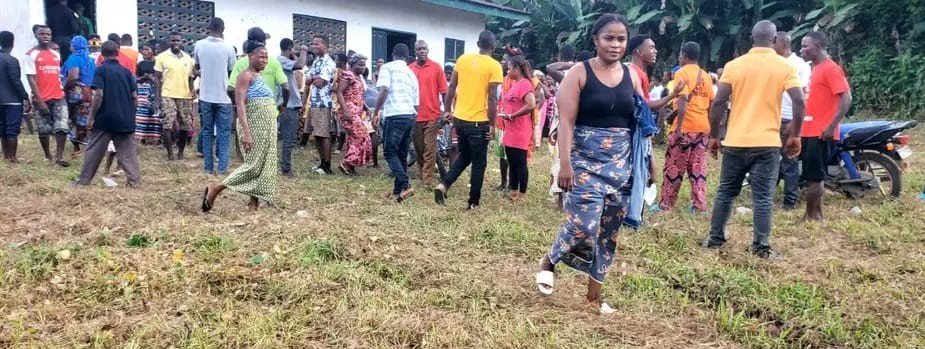
A recent protest in Grand Kru County by communities against Golden Veroleum Liberia (GVL) should serve as a warning to the people of Pleebo-Sodoken District, in Maryland County, where the Maryland Oil Palm Plantation (MOPP) continues to operate on land traditionally belonging to the Nyanbo people, whose communities have long waited for real economic and social benefits from large-scale agricultural ventures.
The afflicted people in Grand Kru County are complaining that Golden Veroleum Company is not keeping its word in respect of employment, in the matter of management, and in the respect of community development, and that they are demanding fulfillment of the agreements that have been made with the company.
The fact that Golden Veroleum had signed a preliminary memorandum of understanding with the Jarbo communities of Weteken and Garraway Beach in April 2014, in which it had promised to offer employment, training, community development, and other advantages, was of particular importance.
Although the agreements in question have been controversial, their existence is important because they pose an important question which the Nyanbo people and the government of Liberia cannot continue to ignore. Namely, why could Golden Veroleum negotiate such an agreement with the people of Grand Kru but not, for example, MOPP with the Nyanbo of Pleebo-Sodoken District?
Our Land Has Been Taken, But Where Are the Benefits?
For a long time the people of the Nyanbo have been depending on their ancestral land for hunting, fishing and farming, but the land leases and new industrial areas have diminished access to these fields, and the effected populations are still struggling to survive amid unemployment, bad roads and lack of medical services.
The people of Gbololu, Gbewien, Old Sodoken, New Sodoken, Beseken, Giwloken, Beseken, Tinuken, Kaken, etc., are seeing their territory become commercial plantations, but are not enjoying the benefits that go with such a venture.
Gbololu is a village that has been hit hard by the concession policy of the company in the area. This has left the inhabitants dependent on about four hundred acres of land belonging to a missionary company, supposedly from the United States of America, based in Connecticut, for their daily bread.
Losing the right to work the land that once sustained them, they must not be excluded from any chance of benefiting from the income of the new industry occupying the old fields. For the development of trade cannot be considered genuine if the communities enduring its effects remain impoverished.
The Nyanbo People Need a Binding Community Agreement
The present framework of the contract between the CRC and MOPP, and the Government of Liberia on the other hand provides for scholarships, community development and other benefits. However, if these are to be included in the community MOU, they must be reviewed and where necessary be translated into such a document, indicating clearly the rights and obligations of the MOPP and every community affected.
Under the agreement, which must be measured in terms of a viable number of jobs offered to locals of suitable qualifications, it must be possible to establish training in the sciences and management, transparently governed scholarship funds, the protection of agricultural land, environmental monitoring, and projects of social and economic development which take into account the real needs of the affected areas.
Particular attention should be paid to the alleged development fund of 5 dollars per hectare and the scholarship, since the people deserve to be informed as to how much was received, who received it and what development projects were completed.
This community development fund must never become the personal benefit of the chiefs, politicians, members of committees, or influential individuals, since it is destined to benefit the whole of the communities whose lands provide the raw material for the concession.
To do this, scholarships must be distributed based on clear and verifiable criteria, protecting the interests of students in the affected areas, and not distributed through favoritism, personal friendships, or political influence.
Community Representation Must Be Genuine
It is above all for the Nyanbo to achieve unity and a strong leadership in order to maintain their bargaining position with MOPP, and it is in this area that we foresee the greatest difficulty in the future.
Individual chiefs, politicians, or self-appointed representatives of any sort must never be allowed to compromise the collective interests of the communities concerned without prior consultation with and consent of the people.
A comprehensive Memorandum of Understanding must therefore be negotiated by legitimate and elected representatives chosen through an open and transparent process in the affected districts, after consulting with the affected women, youths, farmers, village elders and traditional authorities, and assisted by independent, technical and legal experts to ensure that the interests of the community are fully protected.
In addition, the agreement must contain precise deadlines, independent monitoring, financial accountability and binding dispute-resolution mechanisms. For promises that do not imply a measurable obligation or offer a way to enforce non-compliance offer little protection to the most vulnerable.
The Government Must Take Responsibility
“As the government of Liberia, we cannot continue to allow major investment in our country while the people of the concessionary area struggle to get the benefits associated with the use of their lands, because good governance must ensure that companies fulfill their legal and contractual obligations.
It is therefore necessary to review the existing CRC–MOPP obligations in their entirety, to support negotiations on a community agreement that will protect the legitimate interests of the Nyanbo people.
The National Bureau of Concessions, the Ministry of Agriculture, the Ministry of Labor, the Environmental Protection Agency, and the Maryland County authorities should facilitate a comprehensive review of existing CRC-MOPP obligations and support negotiations toward a transparent community agreement that protects the legitimate interests of the Nyanbo people.
The signing of such an agreement is not a threat to MOPP or to foreign investors. It is an opportunity to achieve a new balance of interests in which the economic success of the region would directly and materially contribute to a better life for all, sustainable development and the education of future generations.
## The Time to Act Is Now
The recent disturbances by Grand-Kro-Proper against Golden Veroleum are an important lesson to the people of Pleebo-Sodoken. Any community which surrenders the rights to its own ancestral land needs to be informed of their rights and, furthermore, must have at its disposal effective redress in case the concession is violated.
The Nyanbo people should not have to make any protests or petitions to be granted the right to receive the benefits to which they are legally entitled.
If the ancestral lands of the Nyanbo are so valuable to the MOPP company as to enable it to work there for many years, they are surely of enough importance to warrant the negotiation of a comprehensive, open and binding contract.
Those from Gbololu, Gbewien, Sodoken, New Sodoken, Beseken, Giwloken, Tambo, Kaken, Tinuken and other affected villages are not asking for alms, but a fair solution, one which recognizes their sacrifices, protects what remains of their environment, and ensures them a meaningful share of the development that is being carried out on their land.
The land may produce palm-oil for the world market, profits for investors, but it must also produce opportunity, self-respect and a better future for the Nyanbo people, for development that enriches a concession without enriching the host community will not be a responsible venture.
MOPP, the government of Liberia, and the legitimate representatives of the Nyanbo people are called upon to reach an agreement that would turn years of hope into a tangible agreement of benefits, enforceable rights, and real and sustainable development.