U.S.-Based Marylander Sounds Alarm Over Gold Mining on Gbololu’s Last Remaining Farmland
Nubo warned that allowing gold mining on the land could deal another devastating blow to a community that has already lost much of its ancestral farmland to large-scale agricultural concessions.
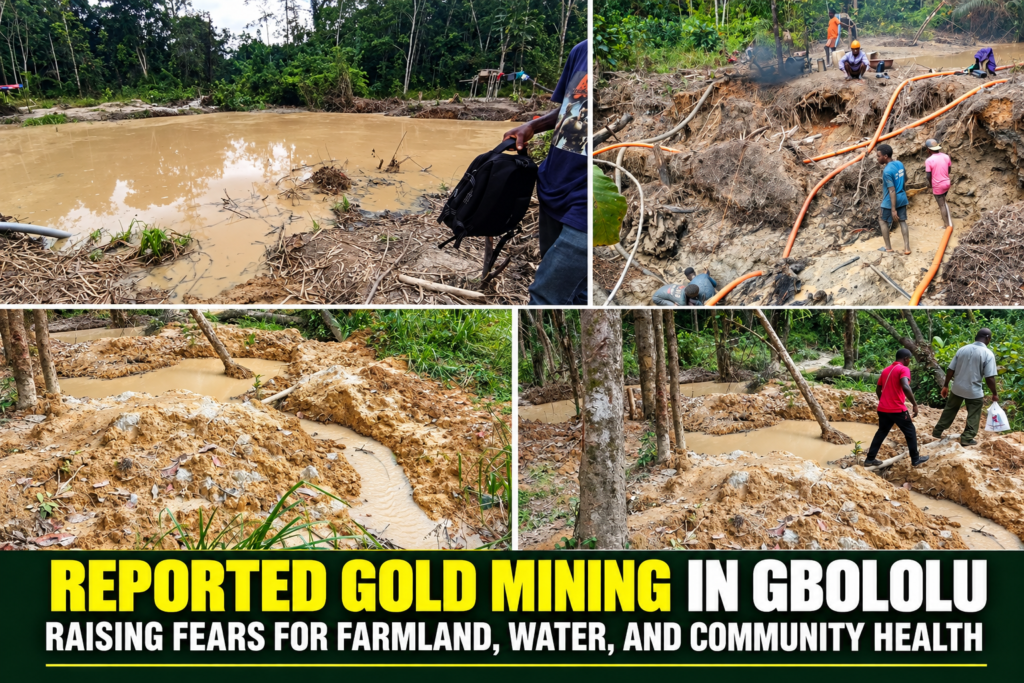
Warns That the Search for Gold Could Destroy the Land That Has Fed Generations
By Langston Joe Wilson, LINA Maryland County Correspondent
PLEEBO, Maryland County, October 23, 2026 – A United States-based Liberian and native of Gbololu, George H. Nubo, has warned his kinsmen against reported gold mining activities on approximately 400 acres of land that represent one of the community’s last remaining sources of agricultural livelihood.
Nubo warned that allowing gold mining on the land could deal another devastating blow to a community that has already lost much of its ancestral farmland to large-scale agricultural concessions.
The land belongs to a missionary organization based in Connecticut, United States, and has remained outside the plantation operations of Decoris and Maryland Oil Palm Plantations (MOPP) because of the organization’s ownership.
For years, residents of Gbololu have relied on portions of the property for subsistence farming, growing rice, cassava, corn, sugarcane, and other crops that sustain their families.
Today, however, this important agricultural resource could be threatened by reported gold mining activities involving individuals from Gbololu and neighboring communities.
In a strongly worded but heartfelt letter to the people of his hometown, Nubo questioned whether the community could afford to sacrifice what remains of its agricultural future for the uncertain promise of gold.
“My people, have we not lost enough land already?” he asked.
According to Nubo, the expansion of concession activities over the years has significantly reduced the land available to residents for farming and other traditional livelihoods.
He recalled that Decoris first occupied substantial portions of the community’s ancestral land, followed by Maryland Oil Palm Plantations, leaving families increasingly dependent on the limited areas that remain accessible for cultivation.
He emphasized that the approximately 400 acres owned by the missionary organization have become particularly important to residents whose survival depends heavily on subsistence agriculture.
“This is not simply about 400 acres of land,” Nubo stressed. “It is about the survival of families, the food our children eat, and the future of generations yet unborn.”
He warned that once farmland is destroyed through uncontrolled mining, restoring its agricultural productivity could become extremely difficult, expensive, or even impossible in some areas.
Gold Today, Hunger Tomorrow?
Nubo expressed particular concern over reports that some residents had allegedly permitted individuals from Pleebo and surrounding communities to conduct gold mining on the missionary-owned property.
He was careful, however, to acknowledge that he had not independently verified the reported arrangements or established whether the missionary organization had authorized any mining activities.
“I sincerely hope this information is not true. But if it is, I beg those involved to reconsider,” he stated.
Nubo said his concern was not motivated by opposition to economic opportunities or the legitimate aspirations of young people seeking employment.
Rather, he questioned whether the short-term financial benefits of gold mining could justify the potential destruction of land that has supported families for generations.
“Gold may put money into someone’s pocket today, but fertile land can put food on the table for generations,” he warned.
He urged residents to consider what would happen when the gold was exhausted, the miners departed, and the land was left damaged.
“What will our children inherit?” he asked. “Will they inherit productive farms, clean streams, and a community capable of feeding itself, or abandoned mining pits and land that can no longer sustain them?”
Warning Over Mercury and Environmental Destruction
Drawing attention to the environmental consequences of poorly regulated gold mining, Nubo warned that the potential use of mercury in gold extraction could introduce serious health and ecological risks.
Mercury, when improperly handled or released into the environment, can contaminate soil and waterways, enter the food chain, and cause long-term damage to human health.
He cautioned that women, children, farmers, and other residents who depend on local water sources could face particular risks if mercury were used and released during mining operations.
Nubo also raised concerns about the destruction of vegetation, removal of fertile topsoil, erosion, and deep excavations that could remain hazardous long after mining activities have ended.
Such excavations could collect stagnant water, create breeding grounds for mosquitoes, and pose physical dangers to children, farmers, and livestock.
Although there has been no independently verified evidence presented that mercury is currently being used at the reported Gbololu mining site, Nubo maintained that the possibility alone warrants serious environmental scrutiny before mining is allowed to proceed.
He stressed that the community must not wait until its water sources are polluted or its farmland is destroyed before demanding answers.
“Development should improve our lives, not destroy the very resources upon which our lives depend,” he declared.
Who Has the Authority to Permit Mining?
Beyond the environmental concerns, Nubo raised an equally important question about ownership and the authority to permit mining on the property.
He emphasized that the approximately 400 acres belong to a missionary organization based in Connecticut and questioned whether any individuals or community representatives could legitimately authorize mining without the knowledge and consent of the lawful landowner and the necessary government approvals.
He called for clarification of who allegedly granted permission, whether any written agreement exists, and whether the missionary organization was consulted.
Nubo maintained that the community’s longstanding agricultural use of the property should not be confused with legal ownership or an unrestricted right to authorize mineral extraction.
He urged traditional authorities to establish the facts before allowing activities that could permanently alter the land.
He also called on the relevant Liberian government institutions, including the Environmental Protection Agency and the Ministry of Mines and Energy, to determine whether any mining activities are taking place and, if so, whether the operators possess the required authorizations and have complied with applicable environmental safeguards.
According to Nubo, protecting the property is not merely a question of landownership but a moral responsibility to families whose livelihoods depend on its continued agricultural use.
A Plea to Traditional Leaders, Women, and Youth
In his appeal, Nubo urged the elders, traditional authorities, women, youth, and other residents of Gbololu to put aside personal interests and consider their community’s long-term survival.
He stressed that decisions affecting the remaining farmland should never be made by a handful of individuals without meaningful consultation with the people whose livelihoods could be affected.
He particularly appealed to young people not to allow the immediate attraction of gold mining to overshadow the value of productive farmland.
For Nubo, the issue is deeply personal.
Gbololu is not merely a place on the map. It is his ancestral home, a community whose land, history, and traditions connect generations of families.
He warned that losing the remaining farmland could further weaken the community’s ability to sustain itself economically and preserve its traditional way of life.
“We cannot continue losing our land and remain silent while the little that is left is placed at risk,” he said.
Nubo urged anyone involved in the reported mining arrangements to suspend further activities or commitments until ownership questions, community concerns, legal requirements, and environmental risks have been properly addressed.
Gbololu Residents Respond, Plan Broader Traditional Consultation
Meanwhile, residents of Gbololu have acknowledged Nubo’s concerns following a town hall meeting held on Saturday, October 17, 2026.
During the meeting, residents reportedly agreed to engage traditional authorities from neighboring communities to address the mining controversy and determine an acceptable way forward.
According to information emerging from the meeting, individuals involved in mining activities in the area are reportedly drawn not only from Gbololu but also from Old Sodoken, Pleebo, New Sodoken, Wechoken, and Gbewien.
Residents indicated that a broader meeting involving traditional authorities of the Klebo Chiefdom would be arranged to examine the situation, including the possibility of removing miners from the disputed area.
The proposed gathering is expected to provide an opportunity for community leaders and other stakeholders to clarify the circumstances surrounding the reported mining activities and consider measures to protect the land.
However, questions remain about whether the missionary organization has been formally informed of the situation, whether mining permissions were granted, and whether the relevant government regulatory institutions have assessed the site.
These questions will need to be answered before a lasting and legally sound resolution can be reached.
A Community at a Crossroads
The unfolding controversy has brought renewed attention to the difficult choices facing rural communities in Maryland County, where agricultural concessions, limited employment opportunities, and increasing pressure on available land have created competing demands for natural resources.
For the people of Gbololu, the issue goes beyond the discovery of gold.
It raises a fundamental question about whether the community will protect the remaining land that has sustained its people or risk sacrificing that resource for financial benefits that may be temporary and unevenly distributed.
Nubo believes the choice should be guided by the interests of future generations.
He maintained that gold, once extracted, is gone, but productive farmland, when properly protected and managed, can continue feeding families for decades.
His message to his kinsmen is therefore both a warning and an appeal: the remaining land must not become another casualty of decisions made without adequate consideration of their long-term consequences.
For a community that has already surrendered so much of its ancestral land, the greatest tragedy would be to lose what remains—not to another concession, but through decisions made by its own people.
And as traditional authorities prepare to deliberate on the matter, one question stands above all others:
When the miners are gone and the gold is exhausted, what will be left for the children of Gbololu?
Important editorial considerations
Before publication, three points should be verified: whether the reported mining is actually occurring within the missionary-owned 400 acres; whether the Connecticut missionary organization has authorized any mining; and whether the reported October 17 town hall meeting formally agreed to seek the removal of miners.
The environmental discussion draws attention to potential risks without claiming that mercury has already been detected or used at the site.
The article also distinguishes the community’s right to use land for subsistence farming from legal ownership of the land and the authority to approve mineral extraction. This makes the story more credible and provides a stronger basis for further investigation.
The revised headline and conclusion emphasize the central human issue: Gbololu cannot afford to lose the land that feeds its people.